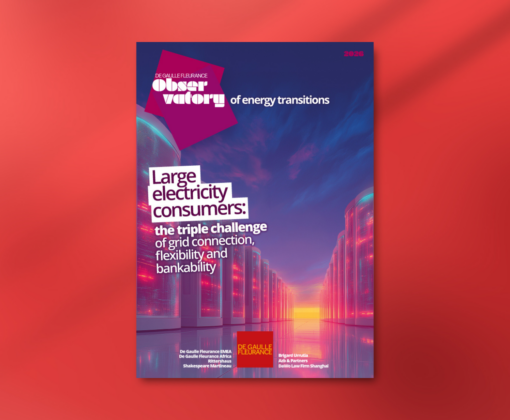
Large electricity consumers: the threefold challenge of grid connection, flexibility, and bankability
Discover the Observatory
De Gaulle Fleurance presents the 7th edition of its Energy Transitions Observatory, produced in partnership with AZB & Partners (India), Brigard Urrutia (Colombia), DaWo Law Firm Shanghai (China), De Gaulle Fleurance Africa (Senegal), De Gaulle Fleurance EMEA (United Arab Emirates), Rittershaus (Germany), and Shakespeare Martineau (United Kingdom). This edition focuses on major electricity consumers and the threefold challenge posed by their grid connection, flexibility, and bankability, with a comparative analysis of the various countries where the contributing firms operate.
Key Figures [1]
+3.6% per year. That is the rate at which electricity demand is expected to grow by 2030—a rate 50% higher than that observed over the past decade.
Electricity consumption is now growing 2.5 times faster than total energy demand, signaling a trend toward the electrification of many sectors.
945 TWh. This will be the global electricity consumption of data centers in 2030—a doubling in just six years, and slightly more than Japan’s total electricity consumption today.
More than 2,500 GW of renewable energy, high-load, and storage projects are currently stuck in grid queues worldwide.
A growing gap between the time required to plan and build new grids (5 to 15 years) and that required for generation projects or data centers (1 to 3 years).
Unprecedented Pressure on Electric Grids
Against the backdrop of the global economy’s accelerating electrification, major electricity consumers—including data centers, artificial intelligence, hydrogen, and electric mobility infrastructure—face a threefold challenge: accessing the electric grid, integrating flexibility mechanisms, and securing financing for their projects.
This international observatory analyzes the applicable regulatory frameworks and highlights contrasting national approaches in China, Colombia, India, France, Germany, the United Arab Emirates, the United Kingdom, and Senegal. While grid access right is generally recognized in the countries studied, it remains subject to technical, administrative, and economic constraints. In practice, access is never automatic and can result in significant delays.
China: Centralized Management and Accelerated Reforms – Carmen Bakas and Sasha Chang (DaWo Law Firm Shanghai)
China is characterized by a highly centralized model in which the state plays a decisive role. A grid access right is guaranteed by law, and major public operators ensure the implementation of national policies. The system relies on close coordination between public authorities, grid operators, and project developers, with significant administrative oversight from the earliest stages of a project.
Faced with rapidly rising demand, Chinese authorities have launched several reforms aimed at simplifying grid connection procedures, encouraging the development of integrated energy systems, and promoting long-term access to green electricity.
However, grid connection remains closely tied to industrial policies and regional priorities, requiring a high degree of adaptability from investors. In practice, conditions vary considerably from one region to another: some inland or western provinces offer more favorable conditions, while several major coastal areas still face constraints related to permitting, capacity, or interconnection.
Furthermore, while China seeks to steer certain new uses of electricity toward more integrated, low-carbon models, the results remain closely tied to local implementation conditions.
Colombia: Regulated and Secure Grid Access – Claudia Navarro and Luis Alfonso Cárdenas Sepulveda (Brigard Urrutia)
In Colombia, the connection of large electricity consumers operates within a highly regulated framework, structured around key public authorities (MME, CREG, UPME) that ensure transparency and access to the grid. The process relies on technical studies, the publication of available capacity, and the issuance of a “Connection Concept,” which secures capacity allocation.
Access is, in principle, open to all, subject only to technical constraints, with strict prioritization mechanisms and financial obligations, including a capacity reservation guarantee that enhances project credibility. Flexibility is encouraged through a voluntary demand response mechanism (DDV), with no mandatory requirements, in exchange for a contractually agreed price.
In terms of bankability, the framework provides strong regulatory visibility but still presents limitations, notably the absence of explicit provisions for lenders or a formalized secondary market for capacity.
France: A Structured Framework Under Reform – Sylvie Perrin, Béatrice Boisnier, Thierry Postif and Elena Divry (De Gaulle Fleurance)
France stands out for its highly structured connection framework for large-scale consumers, based on a clear, transparent, and secure procedure supported by robust contractual tools. The technical and financial proposal is a key step, providing visibility to investors and strengthening the bankability of projects, in a context where effective access to electricity also depends on studies, reinforcement work, and administrative timelines.
Beyond the legal framework, France has implemented innovative mechanisms designed to anticipate needs. Pooling zones allow for the sharing of infrastructure costs and offer greater economic clarity; they reflect an organizational approach focused on anticipating new consumption, rather than a purely case-by-case approach.
More recently, the “HTB3 fast track” mechanism marks a significant step forward. It directs the highest-demand projects to sites identified in advance, with pre-reserved capacity and an accelerated connection process. These tools are part of a broader approach in which France seeks to organize the integration of very high-power projects, while strengthening maturity requirements and queue discipline to limit the impact of “ghost projects.”
Germany: A Fragmented System Facing Congestion Issues – Jens Magers and Ulrich Loetz (Rittershaus)
Germany has a robust but highly fragmented legal framework, with a large number of network operators (more than 860 distribution system operators). While contractual rules are accessible and transparent, access to information regarding available capacity remains limited. Project developers often have to engage in direct discussions with network operators to assess the feasibility of their connection.
Furthermore, Germany currently lacks a systematic plan for pre-equipped zones to accommodate large, electricity-intensive projects. Site selection remains primarily determined by local zoning regulations, while the actual availability of the grid must be verified after the fact. In the event of grid saturation, connection depends on grid reinforcement work that can take several years.
Against this backdrop of growing pressure on infrastructure, some grid operators, depending on the specific case and the capacity requested, require guarantees regarding the maturity and feasibility of projects before proceeding with firm reservations. This approach is now being implemented at the strategic level: Germany is placing greater emphasis on improving transparency regarding available capacity, on reservation procedures linked to project progress, and on more efficient use of existing capacity—precisely to limit bottlenecks and speculative reservations.
Finally, the German regulatory framework is evolving to offer greater flexibility, with flexible connection contracts allowing network operators to temporarily limit the power drawn by facilities in order to better manage local constraints.
India: A Situation That Varies from State to State – Bahram N. Vakil, Aditya Periwal and Shivang Sinha (AZB & Partners)
In India, rapid growth in demand is accompanied by a rapidly evolving regulatory framework. The country offers considerable potential but continues to face structural challenges, particularly in terms of infrastructure.
The proximity of an electricity consumption project to a “green energy corridor” or a “renewable energy zone” significantly improves the chances of obtaining a grid connection. Indeed, these zones are identified through a planning process, coordinated by the authorities, aimed at transmitting electricity from high-potential regions such as the states of Rajasthan, Gujarat, Tamil Nadu, and Karnataka, among others.
The bankability of projects varies considerably from one state to another. Rajasthan is considered particularly attractive, largely due to a combination of factors: access to land on competitive terms, tax incentives, and, depending on specific circumstances, reductions in interstate transmission fees.
Senegal: A Framework Under Development – David Hountondji, Seynabou Kandji and Issakha Ndiaye (De Gaulle Fleurance Africa)
Unlike some more planned models, there are no specific zones pre-connected to accommodate large consumers. However, the authorities strongly encourage companies to set up operations in economic and industrial zones (particularly in Dakar, Diamniadio, and Sandiara), where electrical infrastructure is generally more accessible.
The choice of project location is therefore guided by land-use planning, land ownership, and economic considerations, reflecting a desire for indirect planning of industrial development.
In terms of flexibility, the Senegalese framework imposes specific obligations. Certain large consumers may be required to reduce their consumption upon instruction from the grid operator, particularly as part of load shedding or grid balancing mechanisms. These measures, governed by regulations and contracts, may give rise to financial compensation.
United Arab Emirates: A Decentralized Framework Based on Contractual Agreements – Racha Wylde (De Gaulle Fleurance EMEA)
The United Arab Emirates presents a unique model characterized by a high degree of decentralization of energy authority. In the absence of a single federal authority, regulation of the electricity sector falls under the jurisdiction of each emirate, including Abu Dhabi, which is the primary focus of this study.
Unlike some more centralized systems, there is no structured mechanism for pre-connected zones or sites designated for large consumers. Each project is handled on a case-by-case basis, requiring specific studies and the negotiation of connection terms on a case-by-case basis.
The connection process revolves around the signing of a connection contract and a supply contract, which constitute the main legal instruments governing the relationship between the project developer and the grid operator. This framework thus offers a certain degree of flexibility to investors, but in return involves a high level of negotiation.
United Kingdom: A Rapidly Evolving Framework – Sushma Maharaj, Andrew Whitehead, Kristine Malok and Matthew Collinson (Shakespeare Martineau)
The United Kingdom, for its part, has a mature market but is facing growing pressure on its grid connection capacity. Growing waiting lists and grid congestion are now major challenges for project developers. In this context, the UK Department for Energy Security and Net Zero has launched a consultation on how the grid connection process should be modified to prioritize strategic projects, particularly data centers.
In addition, the government recently introduced a set of reforms regarding grid connection, known as TMO4+, which shifts from a “first-come, first-served” queueing system to an approach prioritizing the maturity and strategic nature of projects (“first ready and needed, first connected”), in order to accelerate renewable energy generation and storage projects.
In terms of flexibility, the UK system relies primarily on an incentive-based approach. Large consumers can voluntarily participate in demand response programs, for which they are compensated by the grid operator, without any general obligation to do so. This approach could, however, evolve as grid constraints intensify.
“This report shows that, in the face of growing electricity demand, connecting large consumers is no longer just a technical issue, but a genuine strategic challenge for public policy and economic competitiveness,” observe Sylvie Perrin, Béatrice Boisnier, Thierry Postif, and Eléna Divry, lawyers at De Gaulle Fleurance. “The bankability of projects remains closely linked to the stability of the regulatory framework, the predictability of costs and connection timelines, as well as planning mechanisms where they exist. The flexibility lever, intended to regulate electricity consumption, remains largely untapped, even though it could help better balance supply and demand.”
[1] Source : AIE
Discover the Observatory
Authors








Snel
DaWo Law Firm Shanghai

N. Vakil
AZB & Partners
Sinha
AZB & Partners

Periwal
AZB & Partners

Navarro Acevedo
Brigard Urrutia

Malok
Shakespeare Martineau

Magers
Rittershaus

Loetz
Rittershaus
Press contacts :
Constance Baudry, +33 (0)6 82 43 69 62,
constance.baudry@agence-constance.fr
Djibril Sagot,
djibril.sagot@agence-constance.fr